Golf Fitness: Exercises for a More Powerful Swing
Quick Answer: Golf distance comes from rotational speed, not from swinging harder. Train four things: rotational power (medicine ball throws, cable rotations), thoracic and hip mobility, anti-rotation core strength, and single-leg balance. Two 40-minute sessions a week plus a 5-minute dynamic warm-up before every round is enough to add meaningful clubhead speed and reduce the back pain that sidelines so many golfers.
You’ve been swinging out of your shoes for two seasons and your drives haven’t gained ten yards.
Meanwhile the guy in your group who’s twenty pounds lighter than you is out there by thirty.
Golf is far more athletic than it looks, and the distance gap between you two isn’t effort. It’s rotation — and rotation is trainable.

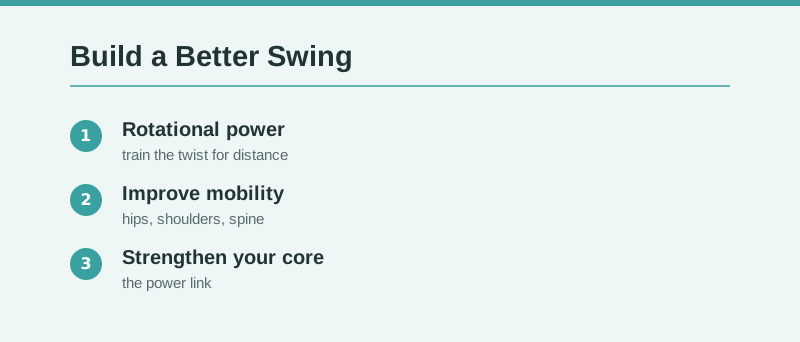
How Do You Build Rotational Power for Golf?
Train the twist, and the distance follows.
The golf swing is fundamentally a rotational movement in which power sequences from the ground, through the hips, through the torso, and out through the arms. Clubhead speed comes from how fast that sequence unwinds — not from how hard you pull with your arms.
The three exercises that matter most:
1. Rotational medicine ball throws. Stand side-on to a wall, 6–8 feet away, holding a 6–10 lb medicine ball at chest height. Rotate away, then explosively rotate through and throw the ball into the wall. Catch and repeat. Dose: 3 sets of 8 per side. Explosive intent on every rep — this is a speed exercise, not a strength one, so stop the set when the throws slow down.
2. Cable or band rotations. Anchor a band at chest height, stand side-on, and rotate away from the anchor with straight-ish arms, driving from the hips rather than the shoulders. Dose: 3 sets of 10 per side, controlled.
3. Half-kneeling chops and lifts. Kneeling on one knee removes the legs from the equation and forces the torso to do the work. Dose: 2 sets of 10 per side.
The critical cue: initiate from the hips and let the torso follow. If your arms lead the movement, you’re rehearsing the exact fault that costs recreational golfers their distance.
Why Does Mobility Matter So Much for Your Swing?
Because a restricted joint doesn’t stop the swing — it forces a compensation somewhere else, and that compensation is where both distance and back pain come from.
The three areas that limit golfers:
Thoracic spine rotation. The mid-back should provide most of your torso turn. When it’s stiff — and it is stiff in nearly everyone who sits at a desk — the lumbar spine rotates instead. The lumbar spine has very limited rotational range and is not built for it, which is a leading contributor to golfer’s lower back pain.
The drill: open books. Lie on your side, knees bent, arms extended in front. Sweep the top arm across your body and open the chest toward the ceiling. 10 slow reps per side, daily.
Hip internal rotation. The lead hip needs to rotate internally through impact. Restricted here and you’ll slide instead of rotating, losing power and consistency.
The drill: 90/90 hip switches. 10 slow switches, daily.
Shoulder mobility. Limited overhead and cross-body range shortens the backswing.
The drill: band pull-aparts and wall slides. 15 reps each.
Better mobility routinely unlocks distance that no amount of range practice can. Five minutes a day is enough.

What Core Exercises Help Your Golf Swing?
Anti-rotation, not crunches. This surprises most golfers.
Your core’s role in the swing is to transfer power from the lower body to the club, and to resist unwanted movement while the intended rotation happens. That’s a stability job, not a flexion job.
The three that matter:
Pallof press. Band anchored at chest height, stand side-on, press the handle straight out and hold 3 seconds while resisting the twist. 3 sets of 10 per side. This is the single best core exercise for golf.
Plank with shoulder taps. Standard plank, tap the opposite shoulder without letting the hips rotate. 3 sets of 10 per side.
Suitcase carry. Heavy weight in one hand, walk tall for 30 meters. Trains resistance to side-bending, which is what keeps your spine angle consistent through the swing. 4 trips.
A strong, stable center is the foundation every good swing is built on — and it’s the thing that lets you rotate fast without your spine paying for it.
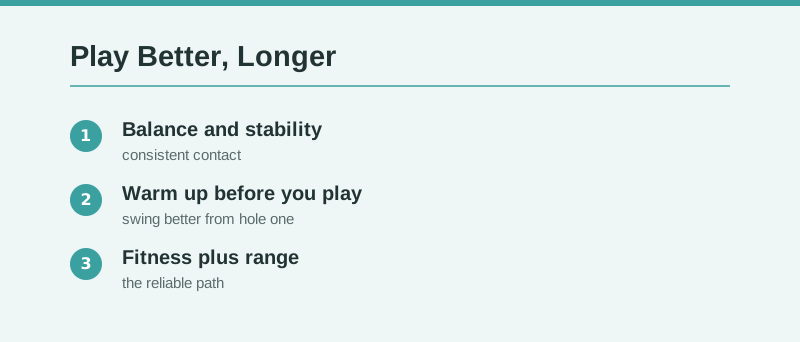
Why Is Single-Leg Balance Underrated in Golf?
Because your weight shifts substantially during the swing, and every mishit late in a round is partly a balance story.
The downswing transfers weight to the lead leg while the body rotates at speed. If you can’t stabilize on one leg, you lose ground contact quality, which costs both power and strike consistency.
The exercises:
Single-leg Romanian deadlift. Hinge at the hip, back leg extending behind, torso lowering. 3 sets of 8 per side. Weighted once bodyweight is easy.
Single-leg balance with head turns. Stand on one leg for 30 seconds while slowly turning your head side to side. Harder than it sounds, and directly relevant — you turn your head during the swing.
Step-ups. 3 sets of 10 per side onto a knee-height box.
Why it shows up late in a round: fatigue degrades balance before it degrades strength. Holes 15 through 18 are where trained balance pays out, and where most amateurs lose strokes.
The 5 Mistakes Everyone Makes With Golf Fitness
- Training for general strength with no rotational work. Bench press and bicep curls do essentially nothing for clubhead speed.
- Skipping the warm-up before a round. Walking to the first tee cold is how golfers strain backs and start with two bad holes.
- Only stretching, never strengthening. Mobility without the strength to control the new range doesn’t transfer to the swing.
- Doing rotational work slowly. Medicine ball throws are a speed exercise. Performed slowly, they build a little strength and no clubhead speed.
- Training the trail side only. Golfers develop pronounced asymmetry from rotating the same direction thousands of times. Training both sides equally is what keeps your back functional at 60 — and it’s the one almost every recreational golfer skips.
What Should You Do Before You Play?
Five minutes. Never skip it.
- Arm circles and band pull-aparts — 15 each
- Torso rotations — 20, gradually increasing range
- Hip circles and leg swings — 10 each direction, each leg
- Bodyweight squats — 10
- Practice swings — 10, starting at half speed and building to full
That’s it. Golfers who warm up properly swing better from the first hole rather than the fourth, and dramatically reduce the risk of the back strain that ends seasons.
It’s the simplest golf-fitness habit available and the one with the best return per minute invested. Two 40-minute gym sessions weekly plus this five-minute routine will do more for your golf fitness than another bucket of balls.
Frequently Asked Questions
How can I increase my golf swing speed?
Train rotational power explicitly — medicine ball throws and band rotations performed with maximum intent, 2–3 times a week. Combine that with thoracic and hip mobility work, since restricted rotation caps how fast you can turn regardless of strength. Most amateurs gain speed faster from mobility than from lifting.
Should golfers lift heavy weights?
Moderate strength training helps, particularly deadlifts, squats, and rows for the posterior chain that powers rotation. But max-strength work isn’t the priority — golfers need speed and stability more than absolute strength, so keep loads moderate and prioritize explosive rotational work.
How do I stop lower back pain from golf?
Improve thoracic spine rotation and hip mobility so your lumbar spine stops compensating for both. Add anti-rotation core work for stability, and always warm up before playing. Persistent back pain that continues despite these changes should be assessed by a physiotherapist.
How often should you do golf fitness training?
Two 40-minute sessions a week covers strength, power, and mobility, with daily 5-minute mobility drills alongside. The pre-round warm-up matters as much as the gym work and takes five minutes. More frequent training isn’t necessary and can leave you fatigued for your rounds.
When to Check With a Professional
Lower back pain that persists beyond a couple of days, or any pain that radiates into the buttock or down the leg, needs assessment rather than more stretching. Golfer’s elbow and wrist pain likewise respond well to early treatment and poorly to playing through.
If you have a history of disc injury, a shoulder that dislocates, or a joint replacement, work with a physiotherapist or a TPI-certified golf fitness professional to structure your program — rotational loading at speed isn’t appropriate for every history. Get medical clearance before starting explosive training if you’ve been sedentary or have cardiovascular risk factors.
TL;DR:
- Distance comes from rotational power, not effort. Medicine ball throws with explosive intent, 3 x 8 per side.
- Thoracic rotation and hip internal rotation are the usual limiters. Open books and 90/90s, 10 reps daily.
- Core work should be anti-rotation — Pallof press, plank shoulder taps, suitcase carries. Not crunches.
- Single-leg balance is what saves holes 15 through 18, when fatigue degrades stability before strength.
- Two 40-minute sessions a week plus a 5-minute dynamic warm-up before every round. Train both sides equally.
See It in Motion
Seen here: UPF 50+ Adjustable A-Line Running Skort with Pockets — shop it on bubblelime.com
Keep Reading
This article is for general informational and styling purposes only. Fit, sizing, and product availability may vary.