Why Your Ball Flies Shorter in Autumn and How Much Club to Take
Quick Answer: Expect to lose roughly one to two yards of carry per 10 degrees Fahrenheit of temperature drop from denser air alone, plus a similar amount again from a cold ball, plus significant roll-out on soft ground. In practice that is half a club to a full club more from summer conditions, and most of the loss is in roll, not carry — which is why the number on your rangefinder has stopped being the number you should play to.
You hit it well. It felt like it always feels. It came up ten yards short and stopped where it landed.
Three separate physical effects are working against you, and knowing which is which tells you whether to take more club or to change how you play the shot entirely.

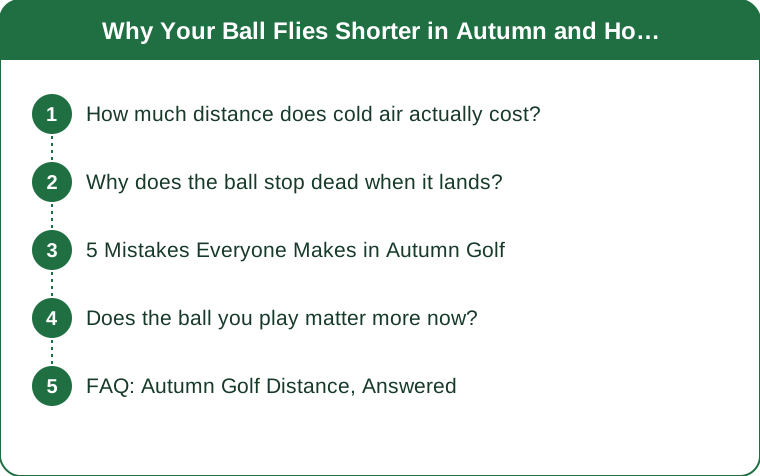
How much distance does cold air actually cost?
Less than people assume, but it is real and it compounds with the other effects.
Cold air is denser. At the same pressure, air density rises as temperature falls — roughly 2 percent denser for every 10 degrees Fahrenheit of cooling. Denser air means more drag on the ball, which reduces carry.
The measured effect is smaller than golfers tend to believe: about 1 to 2 yards of carry per 10 degrees F for a driver, less for shorter clubs. Going from an 80 degree summer afternoon to a 50 degree autumn morning costs you somewhere in the region of 3 to 6 yards of carry on a driver from air density alone.
The ball itself costs you more. A golf ball is a viscoelastic object and its rebound efficiency drops as it cools. A ball that has been in your bag in the boot overnight at 45 degrees is measurably less lively than one at 70. Estimates vary, but a cold ball can cost another 3 to 6 yards with a driver.
Your body costs you something too. Cooler muscles produce less clubhead speed, and heavier clothing restricts rotation. This is often the largest single factor and it is the one nobody measures.
Together, carry loss on a driver from a warm summer round to a cold autumn one commonly runs 10 to 15 yards — meaningful but not catastrophic.
Why does the ball stop dead when it lands?
Because this is where most of your yardage actually went, and it has nothing to do with air density.
Through summer, fairways are firm and a driver might roll 15 to 25 yards after landing. Autumn fairways hold moisture, are softer, and are covered in dew for much of the morning. Roll-out can drop to almost nothing.
That single change is frequently larger than every other effect combined. A drive that carried 200 and ran to 220 in July now carries 192 and stops at 195.
The same applies into greens, but in your favour. Soft greens hold shots that would have bounced through in summer, which means you can be more aggressive at flags and should expect less release.
The practical consequence is that you need to change what you are measuring. Summer thinking is total distance. Autumn thinking is carry distance — how far it flies in the air — because that is nearly all you are going to get.
If you know your carry numbers, use them. If you only know your total distances, subtract roughly 10 to 15 percent for a rough autumn carry estimate and club accordingly.

5 Mistakes Everyone Makes in Autumn Golf
1. Clubbing for the yardage rather than the conditions. A rangefinder tells you the distance. It does not know it is 48 degrees, that the ground is soft, and that the flag is at the back. Take the extra club and swing at the same pace — trying to hit a shorter club harder is where autumn rounds fall apart.
2. Leaving the balls in the car overnight. A cold ball is a slow ball. Keep two in an inside pocket and rotate them every few holes, which keeps them meaningfully warmer than ambient. This is legal for ordinary play; artificially heating balls with a device is not permitted in competition.
3. Under-warming-up. A cold first tee is where most bad autumn rounds are decided. Ten minutes of movement and progressive swings changes the front nine considerably.
4. Wearing too many layers on the torso. Bulk across the chest and shoulders restricts rotation and costs more clubhead speed than the cold does. One good thin thermal layer beats three ordinary ones, and keeping hands warm between shots does more than adding a jumper.
5. Playing the same shot into greens. Soft greens are an opportunity. Fly it at the flag rather than landing it short and running it up — the summer bump-and-run stops working when the ground is wet.
Does the ball you play matter more now?
Somewhat, and it is one of the few equipment decisions with a real seasonal answer.
Softer, lower-compression balls are less affected by cold than firm high-compression ones, because they still compress adequately at lower clubhead speeds and lower temperatures. If you play a firm premium ball and your swing speed is moderate, switching to a softer model through autumn and winter is a reasonable adjustment.
The effect is bigger for slower swing speeds. A fast swing compresses a firm ball adequately even when cold. A moderate one may not, and the loss is proportionally larger.
Beyond the ball, grips matter more in autumn than any other equipment factor. Wet or cold hands on worn grips means grip pressure rises, forearms tense, and clubhead speed falls. A dry towel, a spare glove and reasonable grips are worth more yards than anything you could buy.
Keeping your hands genuinely warm between shots — pockets, hand warmers, a mitt on the trolley — is probably the highest-return autumn adjustment available, and it costs almost nothing.
FAQ: Autumn Golf Distance, Answered
How much extra club should I take on a cold morning?
As a working rule, half a club for every 20 degrees Fahrenheit below your normal playing temperature, plus allowance for soft ground killing your roll. In practice most people find one extra club covers a cold autumn morning on approach shots.
Should I tee it lower in cold weather?
Not for distance reasons. Tee height should stay where it produces your best strike. If it is windy, teeing slightly lower and playing a lower flight is a wind adjustment rather than a temperature one.
Do hand warmers in the pocket help my swing or just my comfort?
Both. Cold hands increase grip pressure involuntarily and reduce feel, which affects both distance control and short game touch. Keeping hands warm is one of the few autumn interventions that measurably improves scoring, not just enjoyment.
TL;DR:
- Cold air costs about 1 to 2 yards of carry per 10 degrees F; a cold ball costs a similar amount again.
- Lost roll-out on soft ground is the biggest factor — think carry distance, not total.
- Take one more club and swing the same, rather than swinging harder.
- Keep balls and hands warm, use one thin thermal layer rather than bulk, and warm up properly.
Play your carry numbers for the rest of the season and the ten-yards-short problem largely disappears.
See It in Motion
Seen here: UPF 50+ Adjustable A-Line Running Skort with Pockets — shop it on bubblelime.com
Keep Reading
This article is for general informational and styling purposes only. Fit, sizing, and product availability may vary.