Why Greens Get Slower in Autumn and How to Adjust Your Putting Speed
Quick Answer: Autumn greens are slower for three stacking reasons: cutting heights go up as courses ease off maintenance for winter, growth is fresh and soft in the cooler wetter weather rather than heat-stressed and firm, and morning dew and surface moisture last for hours instead of minutes. A green running at 10 on the stimp in August can be running at 8 or lower in October, which is roughly 15 to 20 percent more pace needed on a 20-foot putt. Fix it in the practice green in five minutes, not on the fourth hole.
The reason this costs so many shots is that nobody adjusts. Golfers arrive with August calibration, leave three putts short in the first six holes, over-correct, and then run the next four past.

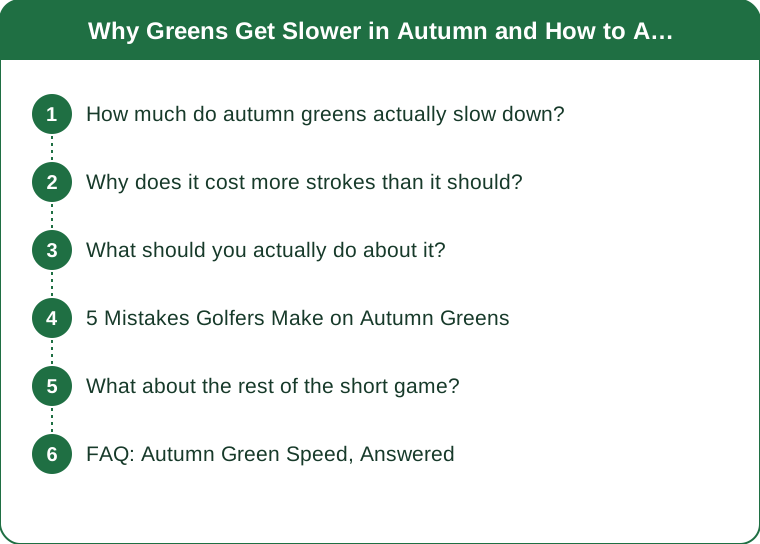
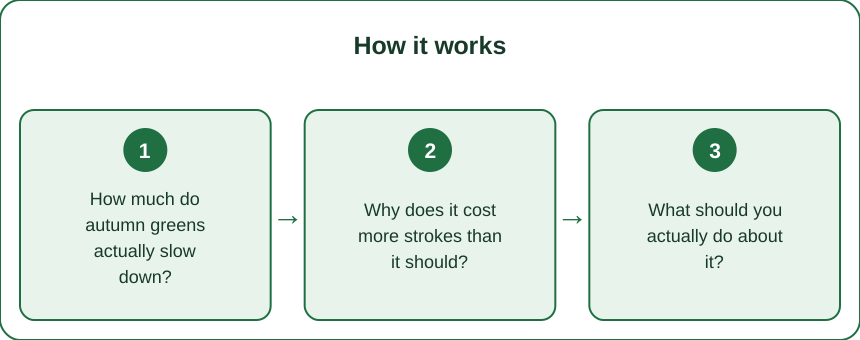
How much do autumn greens actually slow down?
Typically one to two feet on the stimpmeter between peak summer and mid autumn, and on some courses more. A club green at 10 to 10.5 in August is commonly 8.5 to 9 by mid October.
Cutting height is the largest single factor. Greenkeepers raise the height of cut going into autumn to build root reserves and protect the surface through winter. A change from 3mm to 4mm sounds trivial and is a substantial change in ball roll.
Growth rate changes the surface. Cool, moist autumn conditions produce soft, actively growing leaf, which offers more resistance than the hard, heat-stressed grass of late summer.
Moisture is the factor golfers underestimate most. Dew lingers on an October morning until well past 10am, and even after it burns off, the surface holds more water. Wet grass is dramatically slower.
Aeration is the wildcard. Most courses hollow-tine or solid-tine in early autumn, and for two to three weeks afterwards the greens are genuinely bumpy and slow. Playing the week after aeration is a different game and it is worth checking before you get attached to a score.
And it varies within one round. A green in the shade at 8am and the same green at 2pm in sunshine are not the same speed, which is the specific thing that catches out afternoon players who calibrated in the morning.
Why does it cost more strokes than it should?
Because distance control is far more important than line on medium putts, and it is the part people never recalibrate. On a 20-foot putt, a 10 percent error in pace costs you two feet. A 10 percent error in read costs you a few inches.
Short putts hide the problem and long putts expose it. Inside six feet you can hit it firmly and get away with a speed error. From 25 feet you cannot, which is why three-putts spike in autumn while the scorecard offers no obvious explanation.
People over-correct after the first two short ones. Two putts left short produces a defensive over-hit, and the swing between the two is a bigger error than the original miscalibration.
Slower greens also break less. This is the second-order effect almost nobody accounts for. A slower ball is in contact with the surface for longer, but it is also being struck harder, and the net effect on a typical club green is that the ball holds its line more than it did in summer. Playing your August borrow on an October green means missing on the high side.
Uphill putts become much more punishing. The pace penalty compounds with the slope, and a 15-foot uphill putt in October needs strikingly more than the same putt in August.
And downhill putts get easier, which is a small consolation and worth knowing - the terrifying downhill four-footer is far more manageable at this time of year.
What should you actually do about it?
Spend five minutes on the practice green before every autumn round, and spend it on pace rather than on holing putts. This is the whole fix and it takes less time than tying your shoes.
Use the ladder drill. Put three balls down and roll them to 15, 25, and 35 feet without a target hole, just trying to stop them at markers. Repeat until the third set is close. You are recalibrating your feel, not practising a stroke.
Roll a few putts on the actual first green if it is open. Practice greens and course greens are frequently cut differently, and this is a common and unhelpful discrepancy.
Reduce your break allowance by roughly a fifth on slower greens. Start there and adjust, rather than trusting a read that was calibrated on faster surfaces.
Commit to hitting past the hole. On slow greens, the classic instruction to get the ball 18 inches past becomes more important, not less, and most autumn three-putts start with a putt that never had a chance.
Recalibrate again after the turn if you started early. A morning round that begins on dew-soaked greens and finishes on dried ones covers a range of speeds, and the back nine is a different surface from the front.
And check whether the course has aerated recently. If it has, accept it and play accordingly. Trying to putt normally on freshly tined greens is a fast route to a ruined afternoon.

5 Mistakes Golfers Make on Autumn Greens
1. Warming up on the range and skipping the practice green entirely. The range tells you nothing about green speed, and green speed is the variable that has actually changed since your last round.
2. Playing the same break as in summer. Slower greens hold the line more, and playing August borrow on October greens means a steady diet of misses on the high side.
3. Over-correcting after two short putts. The classic sequence is short, short, six feet past. Make one deliberate adjustment based on the practice green rather than an emotional one based on the last miss.
4. Ignoring the wet-to-dry change through the round. The third mistake surprises even good players - they calibrate perfectly at 8:30am on dewy greens and never notice the surface has changed by 11.
5. Putting from off the green out of habit. In summer the fringe is tight and putting from off the surface is often the percentage play. In autumn, wet fringe grass and leaf litter make that roll wildly unpredictable, and a chip becomes the safer option.
A sixth: leaving the flagstick decision on autopilot. On slow greens more putts arrive at the hole with less pace, and leaving the stick in helps rather more than it does in summer.
What about the rest of the short game?
Chips check up far more. Soft, moist autumn turf grabs the ball, and shots that ran out six feet in August stop almost dead. Land the ball further forward than instinct suggests.
Bunkers get heavier. Wet sand is dense and the club does not slide through it the same way. Take more sand and swing harder rather than trying to pick it clean.
Approach shots stop faster too, which means the whole strategy of the hole changes. Flying it to the pin is more viable than it was in August, when everything released to the back.
Leaves are a genuine hazard rather than an aesthetic. A ball in leaf litter is not just hard to find - under the rules there is relief available in some situations and not in others, and it is worth knowing which before you need it.
Lies get worse everywhere off the fairway. Longer, wetter grass in the rough grabs the hosel and shuts the face, so expect more left misses from the rough than you get in summer.
And your ball flies shorter through cold air anyway. Combine a shorter carry with a green that stops the ball and the club selection changes on almost every approach - typically one more club than the same shot in August, sometimes two on a genuinely cold morning.
FAQ: Autumn Green Speed, Answered
How much slower are autumn greens really?
Commonly one to two feet on the stimpmeter versus peak summer, which on a 20-foot putt means roughly 15 to 20 percent more pace. Directly after aeration it can be considerably more.
Do slower greens break more or less?
Less, in practice, on typical club greens. Reduce your break allowance by about a fifth as a starting point and adjust from what you see.
Should I change putters or grips for the winter?
No. This is a calibration problem, not an equipment one. Five minutes on the practice green fixes more than any equipment change will.
Why do the greens feel different on the back nine?
Usually moisture. Dew and overnight water burn off through the morning, so a round that starts at 8am finishes on a measurably faster surface than it began on.
Is it worth playing the week after aeration?
For a social round, fine. For anything you care about scoring in, wait two to three weeks - the surface genuinely does not roll true until the holes have healed.
TL;DR:
- Autumn greens typically run one to two feet slower on the stimp than August, from higher cutting heights, softer growth, and lingering moisture.
- That is roughly 15 to 20 percent more pace on a 20-foot putt, and pace errors cost far more strokes than read errors.
- Slower greens also break less - reduce your break allowance by about a fifth to start.
- Five minutes of ladder drills on the practice green before the round is the entire fix.
- Recalibrate after the turn if you started early, because dew burning off changes the surface mid-round.
Check whether the course has aerated recently before you get attached to a score. Freshly tined greens are a different game and no amount of good putting overrides them.
See It in Motion
Seen here: UPF 50+ Pleated Running Skort with 26” Leggings & Pockets — shop similar styles on bubblelime.com
Keep Reading
This article is for general informational and styling purposes only. Fit, sizing, and product availability may vary.