Why Your Scores Get Worse in Late August Even as Your Swing Improves
Quick Answer: Late August courses play differently in three ways that all cost strokes. The ground is at its firmest and fastest of the year, so shots that stopped in June now release through the green. Greens are stressed and often being managed differently - firmer, sometimes slower, with more variable roll. And the light and the temperature change through the round, meaning a shot at 7am and the same shot at 11am fly different distances. None of this is a swing problem, and adjusting for it is worth more strokes than a lesson.
You are hitting it better than you did in June. The ball striking feels solid, the misses are smaller. And you shot four strokes worse than you did on the same course two months ago.
Late August is when the course, rather than the golfer, does most of the work on the scorecard.

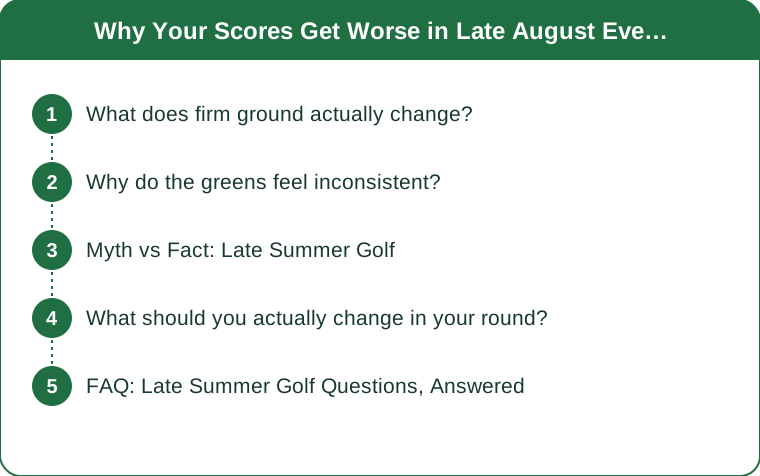
What does firm ground actually change?
Everything about where the ball finishes.
By late August, most courses have been through a full summer of heat and traffic and are as firm as they get all year. Fairways run further, greens release more, and the ball that carried 155 to a pin and stopped is now carrying 155 and finishing thirty feet past.
The strategic consequence is that your carry number stopped being the number that matters. In soft June conditions, carrying it to the flag is the play. In firm late-August conditions, you are playing to a landing spot short of where you want to finish, and that is a genuinely different way to pick a club.
This punishes the approach shot most. A well-struck shot to the middle of a firm green ends up on the back fringe, and a slightly long one is over. The scoring pattern of a late-August round is usually more shots from behind the green than in front of it - and back-of-green chips onto a firm, fast surface are considerably harder than the front-side version.
Off the tee, the same firmness is mostly a benefit and partly a hazard. You will get more roll, which means bunkers and hazards that were carryable in June are now in play at the end of your run-out. Check where the trouble ends, not where it starts.
Why do the greens feel inconsistent?
Because late August is when greens are most stressed and most actively managed.
Cool-season putting surfaces - the bentgrass and poa most northern courses use - are at their annual low point after a summer of heat. Superintendents typically respond by raising the mowing height slightly, reducing rolling frequency and increasing watering to keep the grass alive.
The result is a green that is often slower than it was in June but firmer, which is an unusual combination and a genuinely confusing one to putt. Your eye reads a firm surface as fast, and it is not.
There is also more variability green to green than at any other point in the season. Shaded greens and greens with poor air circulation suffer most in summer heat, so the eighth green may be running significantly differently from the second. In June they were all the same. In late August they are not.
The practical adjustment: spend the practice green time on speed, not on line, and re-calibrate on the first two greens rather than assuming the practice green matches. Aeration season is also approaching or underway at many courses, and a recently aerated green rolls slower and less predictably for a couple of weeks.
Expect three-putts from long range and play more conservatively to leave uphill putts. Uphill is worth more in late August than at any other time, because downhill on a firm surface is where the big misses live.

Myth vs Fact: Late Summer Golf
Myth: The ball flies further in the heat, so I should club down all summer. Fact: Air density does fall with heat and the ball does fly slightly further - but the effect is modest, and by late August the mornings are cool enough that the same course plays two different ways in a single round. The 7am tee shot and the 11am tee shot are not the same shot, and playing your summer numbers all round is a common cause of early-round shortsiding.
Myth: Firm conditions favor the better player. Fact: Firm conditions reward strategy more than ball striking. A player who plans for release and picks conservative landing spots will beat a better striker who is playing carry numbers, because the strategic error compounds on every approach.
Myth: Dry rough is easier than wet rough. Fact: Late-August rough is often thin and dry at the top but the ball settles down to the base, which is a harder lie than it looks. Thin dry rough produces more flyers than lush rough does, because the grass is less able to grab the club face - meaning a shot that comes out hot and long with no spin.
Myth: My distances are fixed. Fact: Ball speed and carry vary with temperature, humidity and altitude enough to matter on approach shots. Cold morning air alone is worth roughly a club on a cool late-August morning compared to a hot afternoon.
What should you actually change in your round?
Four adjustments, all of them about planning rather than technique.
Play to a landing spot, not a pin. On firm greens, pick where you want the ball to land and accept the release. On most late-August approach shots this means one less club than your carry number suggests, aiming for the front third of the green rather than the flag.
Aim to leave the ball below the hole. On firm, fast surfaces the downhill putt is where doubles come from. Being twenty feet below the pin is meaningfully better than eight feet above it.
Recalibrate on the front nine. Assume the first two or three holes are your calibration for the day’s conditions, and be conservative on them. Firmness varies enormously by course and week, and last month’s numbers are not this week’s.
Adjust for the temperature change through the round. A morning round that starts at 60F and finishes at 85F is a round where your distances change by roughly a club from front nine to back. Most people club correctly for one half of the round and wrong for the other.
And manage the physical side. Late August rounds are still hot in the afternoon, and dehydration measurably degrades putting and decision making before it affects ball striking. The back-nine collapse that feels mental is frequently fluid. Drink before you are thirsty, and eat at the turn.
FAQ: Late Summer Golf Questions, Answered
How much shorter does the ball actually fly in cool morning air?
Roughly one club between a 55F morning and an 85F afternoon for most players, with the effect larger on longer clubs. The most common late-summer scoring leak is playing summer numbers in a cool morning and coming up short on every approach for six holes.
Should I change clubs for firm greens or change my target?
Target first. Picking a landing spot short of the pin and letting the ball release is a more reliable adjustment than trying to hit a shot with extra spin, and it does not depend on execution. Change the club only when the landing spot you want is a different distance.
Why is my short game so much worse right now?
Firm, tight lies are the hardest surface to chip from, and late August produces the tightest lies of the year. There is no cushion under the ball, so a slightly heavy strike bounces the club into the ball and a slightly thin one skulls it. Using a lower-lofted club and playing a running shot removes most of the risk.
TL;DR:
- Late August ground is at its firmest - carry numbers stop being finish numbers, and most misses end up long.
- Greens are stressed, often firmer but slower, and vary more green to green than at any other time.
- Play to a landing spot short of the pin and leave the ball below the hole.
- A cool morning is worth about a club compared to the hot afternoon of the same round.
- Dry thin rough produces flyers - it plays harder than it looks.
- Recalibrate on the first three holes rather than trusting last month’s numbers.
Your swing is fine. The course changed underneath it, and the players who score in late August are the ones who noticed.
See It in Motion
Seen here: UPF 50+ Pleated Running Skort with 26” Leggings & Pockets — shop similar styles on bubblelime.com
Keep Reading
This article is for general informational and styling purposes only. Fit, sizing, and product availability may vary.