Why Your Putting Slips After a Good Front Nine
Quick Answer: Putting deteriorates after a strong front nine mainly because a good score changes your decision-making rather than your stroke. Players start protecting the number: they take longer over the ball, aim more defensively, and decelerate through impact. Green speed also genuinely changes through the day as surfaces dry, which compounds the psychological shift.
The stroke that made the birdies is still there. What changed is everything wrapped around it.

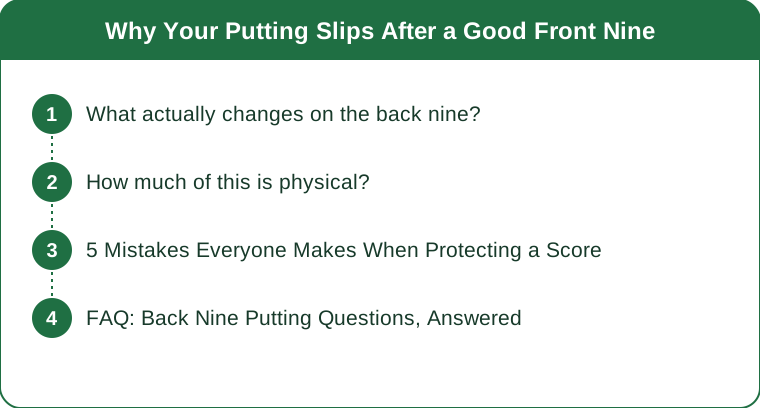
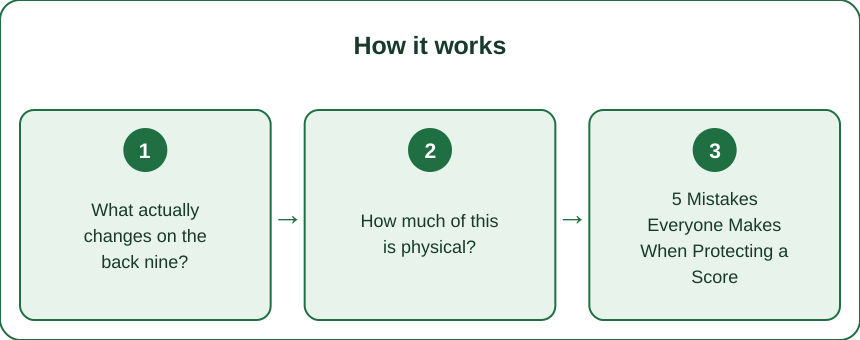
What actually changes on the back nine?
Time over the ball increases. Players who are scoring well take measurably longer on putts because the outcome suddenly matters. Beyond roughly 15 to 20 seconds standing over the ball, stroke consistency degrades — the motor pattern works better when it is not supervised in detail.
Aim gets defensive. With a good score in hand, the instinct is to lag rather than commit, and lagging is a different stroke. The face angle at impact accounts for the large majority of a putt’s starting direction, and a tentative stroke tends to leave the face slightly open.
Deceleration creeps in. Protecting a score produces a shorter, slower follow-through. A decelerating putter face is harder to control than an accelerating one, and it produces poor distance control on exactly the putts you least want to miss.
Green speed genuinely changes. Morning greens carry dew and moisture and run slower; by mid-afternoon the same greens can be noticeably faster as they dry, particularly in late summer. If you calibrated your pace on the first six holes, you are now under-reading the speed.
How much of this is physical?
Some of it, and more than players expect. Grip pressure rises under pressure. Higher grip pressure reduces feel in the hands and shortens the stroke, which is the mechanical version of tentativeness.
Fatigue affects the eyes before the arms. Reading a green requires fine visual discrimination of slope, and visual attention degrades with time on the course and with dehydration. Late-round misreads are frequently vision and concentration rather than technique.
Hydration matters more than it sounds. Even mild dehydration measurably affects fine motor control and concentration. On a warm late-summer round, most amateurs finish meaningfully under-hydrated.
Foot position drifts. As players tire, stance width narrows slightly and posture rises, which changes eye position relative to the ball and therefore changes how the line looks.

5 Mistakes Everyone Makes When Protecting a Score
1. Switching to lag putting from 12 feet. Inside about 15 feet, a committed stroke at the hole is both more likely to go in and, counterintuitively, leaves a shorter second putt on average than a defensive one that dies short and off-line.
2. Re-reading the putt from a third angle. The second read is usually useful; the third read almost always introduces doubt without adding information. Pick a line and go.
3. Slowing the pre-shot routine. The routine should take the same time it did on the second hole. Stretching it out is the clearest external sign of a player about to miss.
4. Changing the target mid-stroke. Late doubt about the line produces a compensating hand action through impact. It is the single most damaging thing you can do to a putt.
5. Not resetting the speed after the turn. Take one long practice putt on the tenth green specifically to recalibrate pace. Greens are faster than they were two hours ago and almost nobody accounts for it.
FAQ: Back Nine Putting Questions, Answered
Should I look at my score during the round?
Most players putt better when they know the number and have decided in advance how they will play regardless. Uncertainty produces more tentativeness than knowledge does — what hurts is discovering the score at the fifteenth and changing strategy.
Does a heavier putter help under pressure?
Often, yes. Additional head weight makes it harder to decelerate and smooths out a tense stroke, which is why many players switch to a heavier or counterbalanced putter specifically for competition.
How do I stop taking so long over the ball?
Count. A fixed count — two looks at the hole, then go — removes the decision about when to start. Any consistent trigger works; the point is that it is the same every time.
TL;DR:
- A good front nine changes decisions and tempo, not your actual stroke.
- Time over the ball increases under pressure, and stroke quality falls after roughly 15 to 20 seconds.
- Defensive aiming and deceleration cause more misses than misreads do.
- Greens genuinely speed up as they dry through the day — recalibrate pace on the tenth green.
- Keep the pre-shot routine identical, commit to the first read, and drink more than you think you need.
Protect the process, not the number. The number takes care of itself.
See It in Motion
Seen here: UPF 50+ Adjustable A-Line Running Skort with Pockets — shop it on bubblelime.com
Keep Reading
This article is for general informational and styling purposes only. Fit, sizing, and product availability may vary.