Why More Arm Strength Won't Fix Your Golf Swing (It's a Ground Force Problem)
Quick Answer: Golf swing power comes from ground reaction force — pushing into the ground with your legs and rotating through the hips, which transfers up through the torso and out through the arms. Your arms are a transmission, not an engine. Building arm strength to fix a weak swing trains the wrong link in the chain.
You’ve been doing curls and push-ups all winter, and your drives haven’t moved.
Meanwhile the guy at your club who out-drives you by 30 yards has arms like drinking straws. Something in the model is wrong, and it isn’t your effort.

Where Does Golf Swing Power Actually Come From?
The ground.
Specifically: you push down and into the ground with your legs, and the ground pushes back. That’s ground reaction force, and it’s the actual origin of clubhead speed. Your hips rotate, that rotation travels up through the torso, and the arms and club deliver it at the end of the chain.
The arms are genuinely important — but as a transmission mechanism, not a power source. They transfer and direct force generated below them. A stronger transmission doesn’t make an engine bigger.
This is why the arm-strength instinct is so reasonable and so wrong. The arms are the part you can see moving fastest, so they look like where the power lives. What’s actually happening is that they’re moving fast because of what the legs and hips did a fraction of a second earlier.
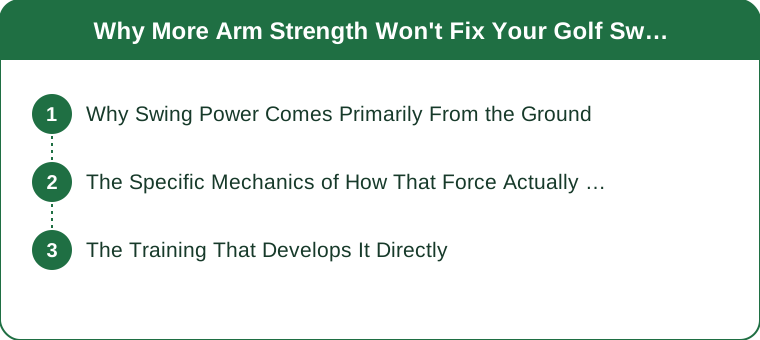
How Does That Force Actually Transfer?
Through a sequence, and the sequence is the whole thing.
The lower body initiates. In the transition from backswing to downswing, pressure shifts and the lead leg begins pushing into the ground. This happens before the arms do anything meaningful.
Hips rotate, then the torso follows. There’s a lag between them — the hips lead, the torso trails slightly, and that separation stores energy across the trunk. Coaches call it the X-factor; the mechanical point is that the segments don’t rotate together.
The kinetic chain unwinds outward. Ground → legs → hips → torso → shoulders → arms → club. Each segment accelerates and then decelerates, passing momentum up the line. The clubhead ends up moving faster than any body segment because it’s at the end of the accumulation.
Sequence errors cost more than strength deficits. If your arms start the downswing — casting from the top — you’ve bypassed the entire chain below. All the leg strength in the world contributes nothing to a swing that didn’t use it. This is why two players with identical fitness can have a 40-yard gap.

5 Mistakes Everyone Makes Chasing Distance
- Training arms and grip and calling it golf fitness. It’s fine training. It just isn’t aimed at the power source.
- Swinging harder with the upper body. This almost always makes the sequence worse, which makes the ball go shorter and less straight.
- Ignoring rotational mobility. You cannot create hip-torso separation you don’t have the range for. Mobility limits are frequently the real ceiling.
- Training rotation only slowly. Strength work matters, but power is rate-dependent — slow rotation doesn’t train fast rotation.
- Buying a new driver first. The third mistake surprises most golfers, but this is the expensive one: equipment optimizes an existing swing rather than fixing the chain producing it.
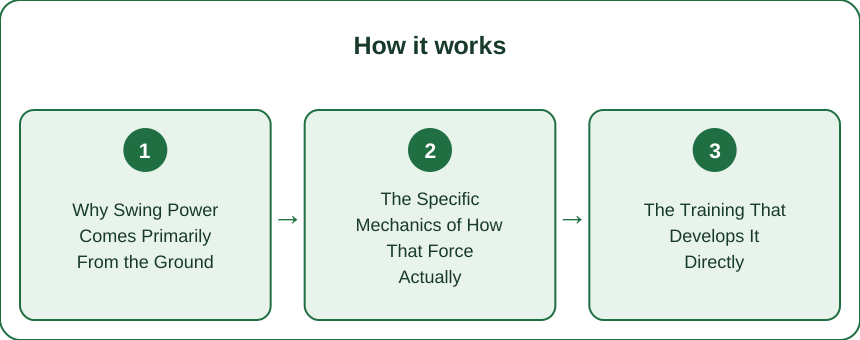
What Training Actually Develops It?
Three categories, and they’re the same ones any rotational athlete trains.
1. Lower body strength — the force production base. Squats, deadlifts, split squats, and single-leg work. The single-leg emphasis matters, because the swing loads legs asymmetrically. Two or three sessions a week, 3 sets of 5–8 on the main lifts.
2. Rotational power — trained fast. Medicine ball rotational throws are the classic and still the best entry point: 3 sets of 5–6 per side, thrown with real intent. Cable or band rotations work too. The key is that these are done explosively, because power is a rate quality and slow work doesn’t develop it.
3. Mobility, especially thoracic spine and hips. This is the constraint people skip. If your upper back doesn’t rotate, your lower back will do it instead — which is both less powerful and a genuinely common source of golf-related back pain. Ten minutes of thoracic rotation and hip mobility work, most days, changes more than an extra gym session for many players.
And get your sequence checked. A coach or a phone video from face-on will show whether your lower body initiates the downswing or your arms do. If the sequence is broken, fix that before adding strength — you’d be feeding power into a chain that doesn’t pass it along.
Practical note: rotational training and mobility work involve a lot of deep hip positions and floor work. Gear that moves with you rather than restricting rotation matters here — squat-proof high waist leggings or a well-fitted skort with real stretch beat anything that binds across the hips.
When to see a professional: persistent lower back pain during or after swinging is a common golf complaint and worth a physical therapist’s assessment rather than more range time. This is general information, not medical advice.
FAQ
Does upper body strength matter at all for golf?
Yes — it contributes to control, club stability through impact, and injury resilience. It just isn’t the power source, so training it in isolation won’t add distance.
How long before ground-force training shows up in my drives?
Mobility improvements can show up within weeks. Strength and rotational power changes typically need 8–12 weeks of consistent work to translate meaningfully into clubhead speed.
Can I train this without a gym?
Largely, yes. Split squats, single-leg work, and med ball throws against a wall cover most of it, and mobility work needs nothing but floor space.
TL;DR
- Power comes from ground reaction force — legs pushing into the ground, hips rotating, energy traveling up the chain.
- Arms are the transmission, not the engine.
- Sequence matters more than strength. Arms initiating the downswing bypasses everything below.
- Train: lower body strength, explosive rotational power, and thoracic/hip mobility.
- See a PT for persistent low back pain rather than adding volume.
See It in Motion
Seen here: UPF 50+ Pleated Running Skort with 26” Leggings & Pockets — shop similar styles on bubblelime.com
Keep Reading
This article is for general informational and styling purposes only. Fit, sizing, and product availability may vary.