The Golf Short Game: Why Practicing It (Not Your Driver) Actually Lowers Your Score
Quick Answer: The short game lowers your score faster than driver practice because most of your shots happen within 100 yards of the green — putting alone is roughly 40% of a typical round. Practice putting first, then chipping, pitching, distance control and bunker play. Make it realistic: hit to different targets from different lies instead of raking 50 identical putts from three feet.
The range is loud, the driver feels great, and there’s genuine satisfaction in watching a ball disappear into the distance.
Now count your last round. How many drivers did you hit? Fourteen, maybe. How many putts? Probably thirty-something.
You’ve been practicing the shot you hit least.

Why does the short game lower your score more than driving?
The arithmetic is unforgiving.
Most of your shots happen near the green. Putting alone typically accounts for around 40% of a round — for a 90-shooter that’s roughly 36 putts. Add chips, pitches and bunker shots and well over half your strokes come from inside 100 yards.
That’s where scores are actually decided. A drive that finds the rough costs you position. A three-putt costs you a stroke, every time, with no recovery available.
And it’s the least-practiced part of the game. Walk any practice facility: the range is full, the putting green has three people on it, and the chipping area is empty. That gap is the opportunity.
The driver is fun. It just isn’t where the score is saved.
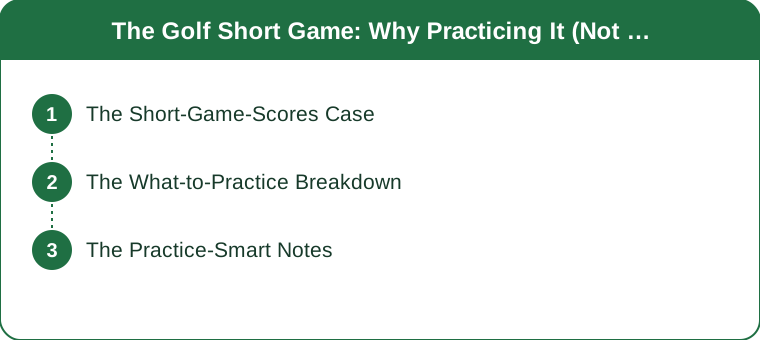
What should you actually practice?
In priority order:
1. Putting. The most shots, so the most to gain. Split your time between short putts (3–6 feet, the ones that cost you strokes when missed) and lag putting from 25–40 feet, where three-putts are born.
2. Chipping. The shots from just off the green. One reliable chip club and a repeatable setup will save you more strokes than five different techniques you half-know.
3. Pitching. The 30–70 yard shots that approach the green. Awkward distances, and the ones amateurs practice least.
4. Distance control. Not direction — distance. Most missed greens and long putts are distance errors, not aim errors.
5. Bunker play. Greenside sand is where confidence collapses fastest. Twenty minutes of practice a week eliminates most of the fear.
6. Green reading. Free strokes. Learning to see slope and break costs nothing but attention.
7. Fundamentals. Setup, ball position and a consistent low-point are what make everything above repeatable.
Add mobility work to the list — hip and thoracic rotation support the swing you’re trying to repeat, and a body that can’t turn will find a way to compensate that shows up in your contact.

How do you practice the short game well?
Shift the time. If you currently practice 80% long game, flip toward 60% short game and watch what happens over six rounds. This single reallocation is the whole article.
Putt the most. It’s the most shots, so it gets the most minutes. A useful default: 20 minutes putting, 15 chipping, 10 pitching, 10 bunker.
Drill distance and feel. Putt to a coin or tee rather than a hole. Chip to three different landing spots. Hit pitches at 30, 50 and 70 yards and note the swing length for each — you’re building a reference table you can use on the course.
Keep it realistic. Don’t hit the same shot 40 times from a perfect lie. Play games: nine different chips from nine different spots, score yourself, try to beat it next week. The course never gives you the same shot twice, so practice shouldn’t either.
Bring the mental side. Short-game shots happen under pressure and near the hole, where tension shows up. Practicing a routine — same breath, same look, same trigger — is practicing the thing that actually fails on the course.
Be consistent. Two focused 45-minute short-game sessions a week beat one four-hour marathon, because feel is built by repetition over time, not volume in a day.
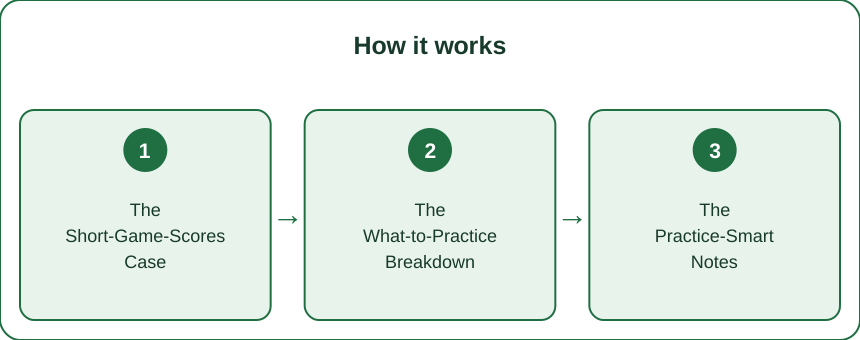
Myth vs Fact: short-game practice
Myth: Driving distance is what separates good players from bad ones. Fact: Among amateurs, short-game and putting differences explain far more scoring variance than driving distance. Distance helps — it just helps less than not three-putting.
Myth: You need a full practice facility to work on the short game. Fact: A putting mat, a chipping net, and any patch of grass covers most of it. Putting improvement in particular is almost entirely a home-practice activity.
Myth: Chipping requires a different technique for every situation. Fact: Most players are better served by one dependable chipping motion and a change of club for different distances. Simplicity repeats under pressure; a wide technique menu doesn’t.
Frequently Asked Questions
How much of a golf round is short game?
Typically well over half your strokes come from inside 100 yards, with putting alone around 40% of the total. That ratio is why short-game practice returns strokes faster than any other kind.
How long should I practice putting each week?
Even 20 minutes twice a week produces noticeable change, especially if you split it between 3–6 foot putts and long lag putts. Consistency matters more than session length — feel decays without regular contact.
What’s the fastest way to lower my golf score?
Stop three-putting and stop wasting shots around the green. That means putting practice with real distance-control drills, one reliable chip you trust, and enough bunker reps that sand stops being a panic situation.
TL;DR:
- Over half your strokes happen inside 100 yards; putting alone is roughly 40% of a round
- Practice priority: putting, chipping, pitching, distance control, bunker play, green reading
- Reallocate practice time toward the short game — this alone changes scores
- Practice realistically: varied lies and targets, not 40 identical repetitions
- Add a consistent pre-shot routine and basic mobility work to make it repeatable under pressure
See It in Motion
Seen here: UPF 50+ Pleated Running Skort with 26” Leggings & Pockets — shop similar styles on bubblelime.com
Keep Reading
This article is for general informational and styling purposes only. Fit, sizing, and product availability may vary.