How to Practise Golf When the Evenings Start Getting Dark
Quick Answer: From late August you lose roughly two to three minutes of evening daylight per day, which is about fifteen minutes a week - by early October, after-work range sessions are gone for most people. The practice that survives indoors is the practice that matters most: putting, short game feel, mobility work, and slow-motion positional rehearsal. What you lose is full-swing ball flight feedback, and the honest answer is you cannot replicate it at home - so use the remaining daylight weeks for full-swing work and shift technical rehearsal indoors now, before you are forced to.
Players who plan the transition in September come out of winter ahead. Players who wait until the range closes come out behind.

What are you actually losing when the light goes?
Specifically ball flight, and it is worth being clear about that because it changes what indoor practice can and cannot do.
Ball flight is feedback you cannot get indoors without a launch monitor. Curvature, launch, and distance are the information that tells you whether a swing change worked. A net tells you contact quality and nothing else - a hooking swing and a straight swing feel identical into a net at two metres.
This is why net practice can make you worse. Grooving a swing without flight feedback means grooving whatever you are currently doing, including the faults. Hitting into a net without a plan is the most common winter mistake in golf.
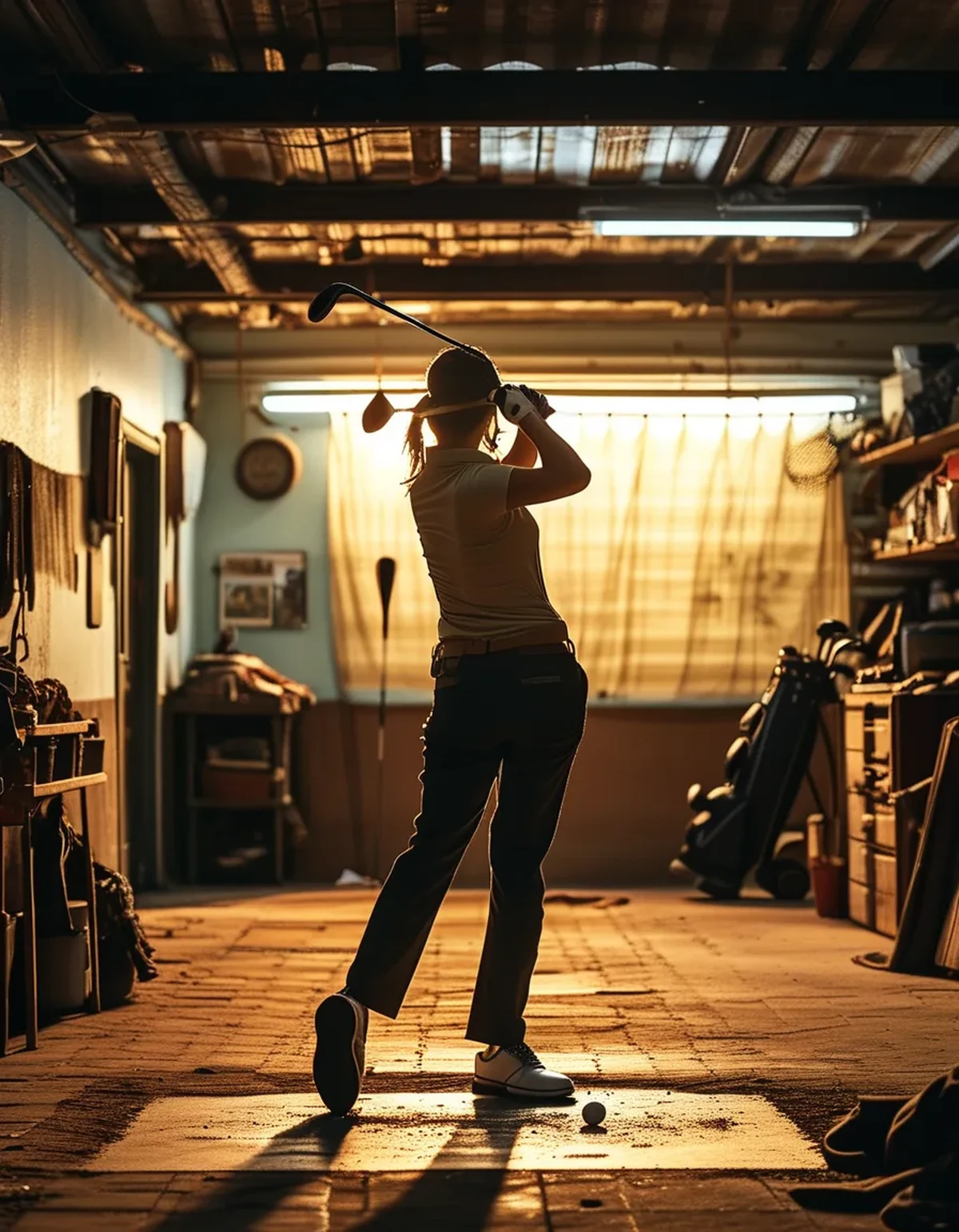
What you keep indoors: everything about the body rather than the ball. Positions, sequence, mobility, tempo, and grip are all trainable in a garage with a mirror.
And what actually improves indoors: putting, which is roughly 40% of your shots and needs a flat surface rather than daylight. Most amateurs have this exactly backwards - they spend the good daylight on the range hitting drivers and then abandon golf entirely when the range closes, when winter is by far the best time to become a better putter.
The seasonal timing: you have maybe six to eight weeks of usable evening range light left. Spend them on the things that need ball flight.
What should you do with the daylight you have left?
Prioritise ruthlessly, because this window is closing.
Full-swing work with ball flight feedback. Anything you are trying to change in your swing - path, face, strike location - needs to be worked on now, while you can see the result. A change you make in October with flight feedback is a change you can rehearse all winter. A change you attempt in January into a net is a guess.
Get one lesson before the light goes, if you get one all year. A coach can give you a clear priority and a rehearsal drill that works indoors. Going into winter with a specific thing to rehearse is worth far more than going in with a vague sense that your swing needs work.
Foot spray or impact tape on the clubface for a few sessions, to record where you actually strike it. That is baseline information you will want in March.
Play more, practise less, in the remaining weeks. Course conditions in early autumn are usually excellent - the ground is still firm, the greens are good, and the courses are quieter. On-course reps are the thing you lose most completely in winter.
Take some video from down the line and face on. Ten seconds of each, in good light. You will want it as a reference point when you are rehearsing indoors in December and cannot remember what you were working on.
What actually works indoors?
Four categories, in order of return.
1. Putting. The highest-value winter practice by a distance. A 3m stretch of carpet and a mirror covers stroke path, face alignment, and start line - which is essentially the whole skill. Gate drills with two tees, distance control on a consistent surface, and a lot of 1m putts. Making a hundred 1m putts a week through winter genuinely changes a scorecard in spring.
2. Mobility and rotation work. The limiting factor in most amateur swings is thoracic rotation and hip mobility, and both respond well to consistent off-season work. Fifteen minutes, three times a week, produces meaningful change over three months - a rotation gain you will feel on the first tee in April.
3. Slow-motion positional rehearsal with a mirror. Not swings - positions. Half-speed, checking one thing at a time. This is where a specific coach-given priority is worth its weight, because rehearsing the wrong position for four months is worse than not practising at all.
4. Short game feel, if you have space. Chipping into a net or across a room onto a towel target trains contact and distance control. Less valuable than putting, more valuable than full swings.
Strength work belongs here too. The off season is when golfers can actually train without it interfering with playing. Glutes, core, and grip strength are the three that transfer most directly to clubhead speed.
Myth vs Fact: Winter Golf Practice
Myth: You should not touch a club in the off season. Fact: Old advice from an era of much heavier equipment and different training. Skills decay, and rotational mobility decays faster. Coming back in April from a complete break means spending six weeks getting back to where you were in October.
Myth: Net practice is good practice. Fact: Net practice is good rehearsal and bad feedback. With a specific position to rehearse and a mirror, it is useful. Hitting balls into a net for volume is not, and it can groove faults invisibly.
Myth: Simulators are just for fun. Fact: A decent launch monitor session gives you the ball flight data you lost with the daylight, which makes it the one form of indoor practice that can genuinely replace range work. Expensive per hour, so use it for measurement rather than volume - one focused hour a month beats four unfocused ones.
Myth: You lose distance over winter and it is unavoidable. Fact: Most winter distance loss is lost mobility and lost strength, both of which are the most trainable things on this list. Golfers who train through winter frequently come back longer.
Myth: Cold weather rounds are pointless. Fact: They are excellent for course management and short game creativity, and you learn to score without your best ball striking. Just expect the ball to go shorter - roughly 2 yards per 10 degrees of temperature drop - and club up rather than swinging harder.
How do you build an off-season routine that survives?
The routine that works is the one that fits into evenings that are dark and cold.
Make it short and repeatable. Fifteen minutes, four times a week beats two hours on a Sunday, both for skill retention and for actually happening. Long sessions get skipped in December.
Put the equipment where you will trip over it. A putting mat rolled out in the living room gets used. A putting mat in the garage under a box does not. This sounds trivial and it is the main determinant of whether winter practice happens.
Attach it to something you already do. Ten minutes of putting while something is on television, mobility work after a shower. Golf practice as a standalone evening event is the format most likely to be abandoned by November.
Keep one measurable thing. Number of 1m putts made out of 50, or a rotation measurement. Something with a number means you can see progress, which is what carries a routine through the dark months.
Book something for spring now. A trip, a match, an early-season competition. A date on the calendar is the most reliable motivator there is, and it converts winter practice from vague maintenance into preparation for something specific.
Plan the return. The first outdoor session in spring should be short and easy - cold muscles and a full swing after four months is a genuinely common route to a back injury. This is general information, not medical advice.
FAQ: Off-Season Golf Practice, Answered
How much daylight am I actually losing?
Around two to three minutes per day in September and October at mid-northern latitudes, which compounds to roughly an hour every three weeks. The change is fastest around the equinox in late September.
Is a home putting mat worth it?
It is the best value golf purchase there is, at almost any price point. Speed will not match a real green - most mats run faster - so use it for stroke and start line rather than distance control.
Should I get a launch monitor?
Consumer models have got genuinely good. If you practise indoors regularly, it converts net practice from rehearsal into real feedback. Use it monthly for measurement rather than daily for volume.
Will my swing feel weird in spring?
Somewhat, always - but far less if you kept mobility and rehearsed positions. The feel comes back within a couple of sessions if the body kept its range of motion.
Is it worth playing through the winter?
If the course is open and you enjoy it, yes - on-course reps are irreplaceable. Adjust expectations on distance and enjoy the quiet. Empty fairways in January are one of the better experiences in the game.
TL;DR:
- You lose about fifteen minutes of evening daylight a week from now - after-work range sessions are gone by early October.
- Spend the remaining daylight on full-swing work, which needs ball flight feedback you cannot get indoors.
- Get a lesson now so you go into winter with one specific thing to rehearse, plus video for reference.
- Indoors, the returns are putting first, mobility second, slow positional rehearsal third.
- Net practice without a plan grooves your faults invisibly. It is rehearsal, not feedback.
- Fifteen minutes four times a week, equipment left out, and one number you track.
Winter is where the gap opens up between players who arrive in April rusty and players who arrive better than they were in October. Almost all of it is decided by what you set up in September.
See It in Motion
Seen here: UPF 50+ Adjustable A-Line Running Skort with Pockets — shop it on bubblelime.com
Keep Reading
This article is for general informational and styling purposes only. Fit, sizing, and product availability may vary.