Your Grip Pressure Is Costing You More Than Distance
Quick Answer: Excess grip pressure restricts wrist hinge, slows clubhead speed by limiting the release, and fatigues the forearms enough to change your swing by the back nine. Most instructors describe a target of roughly 4 or 5 out of 10 — firm enough that the club does not move, loose enough that your wrists stay free. The tell is forearm tension: if your forearms are hard at address, your grip is too tight.
Grip pressure is one of the few swing variables you can change instantly, without a lesson, and feel the difference on the same shot.

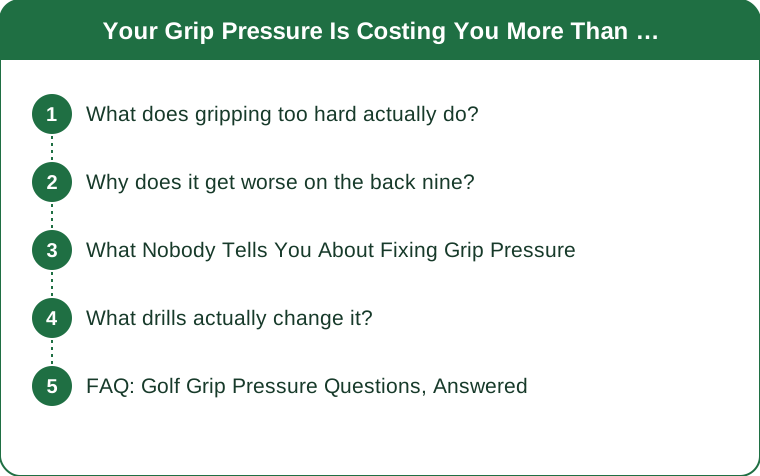
What does gripping too hard actually do?
It shuts down the part of the swing that produces speed.
It blocks wrist hinge. Clubhead speed comes substantially from the release — the stored energy in the wrist angle unloading through impact. Tight hands and forearms lock the wrist joint. You can feel this without a club: squeeze your fist as hard as you can and try to hinge your wrist. The range disappears.
It creates tension up the chain. Grip tension does not stay in the hands. It travels through the forearms into the shoulders and upper back, and a tense upper body cannot rotate as fully. A shorter turn means a shorter swing arc, and arc length is a direct input to speed.
It slows the transition. The change of direction at the top of the backswing depends on the club momentarily lagging behind the hands. Gripping hard drags the club along with the hands instead, which is the mechanism behind casting and the loss of lag.
It amplifies mishits. A tight grip transmits vibration from an off-center strike straight into the hands and forearms, which is why a thin shot stings so much more when you are tense — and why the next swing is usually tighter still.
Why does it get worse on the back nine?
Because forearm endurance is finite, and tension is expensive.
Gripping at 8 out of 10 for four hours is a sustained isometric contraction of the forearm flexors. Those muscles fatigue, and fatigued muscles do two things: they lose fine control, and they compensate by recruiting more.
The pattern most players recognize: the swing feels fine for the first ten holes, then the strike gets inconsistent, distance drops, and it feels like something mechanical broke. Nothing broke. The forearms are tired, so grip pressure went up to maintain the same sense of security, and the tighter grip cost the release.
Heat and cold both make it worse. In heat, sweaty hands make the club feel slippery, so you grip harder to compensate — usually much harder than necessary. In cold, hands stiffen and everything tightens by default.
The equipment fix people skip: worn grips genuinely require more hand pressure to control. Grips are consumable and most golfers play them for years past their useful life. If the surface is shiny and slick, you have been unconsciously gripping harder for a while, and a fresh set of grips is one of the cheapest performance changes in the bag.

What Nobody Tells You About Fixing Grip Pressure
Everyone tells you to hold it like a bird or a tube of toothpaste. Nobody tells you those images make most people grip inconsistently instead of lightly. The problem is that the metaphor sets a target you cannot verify. Use a number instead: 4 or 5 out of 10, where 10 is your maximum squeeze. A number is repeatable; a bird is not.
The pressure should not be even across all fingers. For most players the last three fingers of the lead hand do the holding, and the trail hand is largely along for the ride. People who grip too hard usually do it with the trail hand, which is also the hand that most needs to stay passive.
Light grip pressure feels wrong before it feels right. It genuinely feels like the club is about to fly out of your hands. It will not — the club is held by the fingers of the lead hand and the mass of the swing keeps it in place. Give it a full bucket before deciding.
Pressure should stay constant, not just start low. Many players set up at a 4 and are at an 8 by the top of the backswing. The change is what does the damage, and it is why the drill below focuses on maintaining rather than setting.
Glove condition matters more than glove brand. A worn glove slips, and slipping makes you squeeze. Replace it before it goes shiny in the palm.
What drills actually change it?
Four, in order of how quickly they produce a change.
1. The number call-out. Before each practice swing, say your target number out loud — “four” — and then check at the top of the backswing whether you are still there. Most people discover they are at seven. Awareness alone fixes a large share of the problem.
2. The waggle reset. Before every shot, waggle the club and consciously let the hands soften. This has the added benefit of interrupting the pre-shot tension spiral that builds during the routine.
3. The whoosh drill. Turn a club upside down and hold the shaft near the head, then swing it. The whoosh sound is loudest at the bottom when your wrists release freely. Grip tightly and the whoosh moves earlier and gets quieter. This gives immediate audio feedback with no equipment.
4. The two-club check on the range. Hit five balls gripping at 8, then five at 4. Do not try to swing differently — only change the pressure. Most players see a distance difference on the same club, which is more persuasive than any instruction.
Take it to the course with one cue. On the first tee and again at the turn, check your forearms at address. Hard forearms means reset. That is the whole on-course version.
FAQ: Golf Grip Pressure Questions, Answered
Does grip pressure change by club?
Slightly. Most players use marginally more pressure on short shots and in the rough, where the club is going to be twisted by resistance, and less on the driver where speed is the priority. The variation should be small — going from a 4 with driver to a 5 or 6 out of a lie, not to an 8.
I lose the club at the top. Am I gripping too lightly?
Usually it is a grip position problem rather than a pressure problem — the club sitting in the palm rather than the fingers of the lead hand, which reduces control and forces compensating squeeze. Check where the grip sits across the base of the fingers before adding pressure.
Do thicker grips help?
They can. A grip that is too small for your hand encourages over-squeezing and excessive hand action; a slightly thicker grip quiets the hands. It is worth being fitted rather than guessing, but if you have small-feeling grips and a persistent hook, this is a reasonable thing to test.
TL;DR:
- Tight hands block wrist hinge, shorten the turn and kill the release — the exact things that produce distance.
- Aim for a repeatable 4 or 5 out of 10 rather than a metaphor, and keep it constant through the backswing.
- Forearm fatigue is why the back nine falls apart, and worn grips and gloves quietly push pressure up.
- Use the whoosh drill for instant feedback and the forearm check at address on the course.
- Test 8 versus 4 on the range with the same club — the distance difference makes the case.
It is the cheapest change available: no lesson, no equipment, and you can feel it on the very next swing.
See It in Motion
Seen here: UPF 50+ Pleated Running Skort with 26” Leggings & Pockets — shop similar styles on bubblelime.com
Keep Reading
This article is for general informational and styling purposes only. Fit, sizing, and product availability may vary.